FCC Approves Upper C-Band Plan, Opening 160 MHz for Wireless Auction
The proceeding required extensive coordination with wireless carriers, satellite operators, broadcasters, and aviation stakeholders

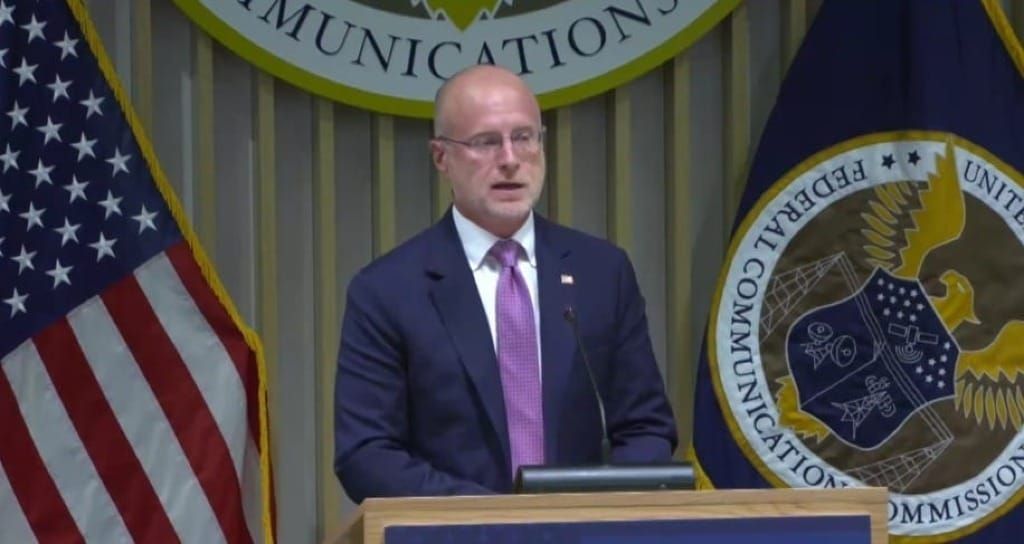
WASHINGTON, July 22, 2026 – America’s top communications regulator is planning to sell more wireless licenses in an effort to keep the country in the vanguard of mobile communications globally.
The Federal Communications Commission voted Wednesday to clear 160 megahertz of Upper C-band spectrum for an upcoming wireless auction.

“America’s leadership in wireless is back after years of falling behind and no new spectrum auctions,” FCC Chairman Brendan Carr said, crediting Congress and President Donald Trump for restoring the FCC’s spectrum auction authority through the One Big Beautiful Bill Act.
“Today’s decision to auction 160 megahertz of the Upper C-band is a really good outcome for consumers,” Carr said. He said the auction, expected next year, combined with spectrum already repurposed in the Lower C-band, will create a “harmonized super band” of 440 megahertz of contiguous midband spectrum for next-generation wireless services.
The order implements a provision of the OBBBA directing the FCC to complete a competitive bidding process for at least 100 megahertz of Upper C-band spectrum by July 4, 2027.
FCC staff moved expeditiously from issuing a proposed rulemaking in November 2025 to a final order in roughly seven months after receiving more than 100 comments from stakeholders.
The commission said the proceeding required extensive coordination with the Federal Aviation Administration and the National Telecommunications and Information Administration because of the competing interests of wireless carriers, satellite operators, broadcasters, and aviation stakeholders.
Carr said diligent coordination allowed the FCC to complete the proceeding “on time, on budget, and with certainty to all stakeholders,” adding that the agency expects most Americans to gain access to services using the spectrum by the end of 2030.
While the order was adopted, it was not unanimous.
Commissioner Anna Gomez, a Democrat, approved the item in part and dissented in part, arguing the FCC should have established a tribal licensing window before proceeding with the auction.
She said numerous tribal governments and organizations had asked the FCC to reserve spectrum licensing opportunities for Tribal Nations and that doing so would have been consistent with the federal government's trust responsibility.
“While I believe the commission should have conducted both a tribal licensing window and an Upper C-band auction within the deadline Congress indicated, I understand the Commission's interpretation of Congress's directive was to move the auction expeditiously,” Gomez said.
Gomez nevertheless praised the FCC’s handling of what she described as a technically and politically difficult proceeding.
Commissioner Olivia Trusty supported the order, calling it “a significant milestone” for U.S. wireless leadership. She said expanding access to midband spectrum would encourage investment in current 5G deployments while laying the foundation for future 6G networks.
Trusty also highlighted the order’s provisions governing satellite relocation and aviation safety, saying the framework balances expanded spectrum use with continuity of existing communications services.
To address aviation safety concerns, the order adopts technical rules intended to protect aircraft radio altimeters operating in adjacent spectrum and establishes a deployment schedule that aligns with anticipated FAA requirements for upgraded radio altimeters.
The order also establishes a transition process to relocate incumbent fixed satellite service operators and provides rebates for eligible aircraft owners and operators required to retrofit radio altimeters.
Carr said Wednesday's action represents only the beginning of a broader spectrum agenda. In addition to conducting the Upper C-band auction next year, he said the commission expects further spectrum auctions before the end of 2028 as additional bands become available.
AT&T welcomed the decision. Rhonda Johnson, executive vice president for federal regulatory relations for AT&T, said the order “keeps America on the path to a stronger wireless future,” praising the FCC for “moving quickly to advance the Upper C-band and for taking a proactive approach to stakeholder coordination across various industries and government agencies.”
ACA Connects President and CEO Grant Spellmeyer said the order begins a lengthy transition process rather than marking its conclusion.
He noted that relocating incumbent cable operators from portions of the Upper C-band will require multiple steps, and said the association intends to work with the FCC and other stakeholders to ensure a smooth migration and fair reimbursement of transition costs.
The FCC unanimously approved several other items at Wednesday's meeting.
FCC replaces satellite licensing framework
Commissioners adopted an order to overhaul the FCC’s satellite licensing rules, replacing the decades-old Part 25 framework with a new Part 100 regime designed to streamline licensing for satellite and Earth station operators.
“Our legacy Part 25 rules were not suited for the long term,” Carr said. “So today we're doing something unprecedented. We're scrapping our old rules in their entirety and replacing them with better new ones. This kind of ambition shouldn't be taken for granted.”
Carr said the reforms are intended to make the United States the preferred location for licensing and operating satellite systems as commercial investment in space accelerates.
“The FCC must do its part to ensure that the U.S. is the best place in the world to launch, to operate, and to license satellite operations,” he said.
Satellite industry groups responded favorably to the action. David Redl, executive director of the SpaceConnect Association, said the streamlined licensing process would allow operators to focus more resources on deploying new satellite services.
“By modernizing its licensing process to improve speed and predictability, the FCC is allowing our members to focus on providing innovative services,” Redl said. The association was established by four major satellite operators: Amazon, Globalstar, Iridium, and Telesat.
“Our members are committed to providing consumers with all the benefits that Non-Geostationary Orbit satellites have to offer, and we look forward to working with the Space Bureau and the rest of the Commission to continue to deliver,” he said.
Trusty said the satellite industry has undergone a dramatic transformation in recent years, driven by investments in low Earth orbit constellations and new manufacturing capacity.
“I've seen this transformation firsthand during recent visits to Amazon Leo and SpaceX manufacturing facilities, where American workers are building and launching the next generation of low Earth orbit satellites,” Trusty said.
“This administration has made clear that it intends to usher in a new era of commercial space leadership by removing unnecessary barriers to innovation. At the FCC, modernizing our satellite licensing framework is a critical part of that effort,” she said.
FCC scales back broadband nutrition labels
Commissioners unanimously approved an order to change the FCC’s broadband “nutrition label” rules, disclosures intended to provide easy-to-understand information about the cost and performance of high-speed internet service plans.
The order narrows certain display requirements. Providers will be allowed to use a hyperlink or icon at the point of sale, rather than displaying the full label, and sales representatives may summarize required label information during telephone transactions instead of reading the label verbatim.
Gomez, who voted to approve the item, said her “preference would have been to display the full label,” rather than a hyperlink or icon but supported retaining broadband labels in customer portals and preserving multilingual disclosure requirements.
She also secured a provision directing the Consumer Protection and Accessibility Advisory Committee to periodically evaluate the labels' effectiveness and accessibility.
Carr said the reforms would result in “a label that's easier for consumers to use, while reducing compliance costs for providers.”
Among the changes adopted, providers will also be allowed to describe variable pass-through fees as an aggregate amount or maximum amount instead of listing every individual fee, while retaining the option to itemize.
The FCC removed references to the expired Affordable Connectivity Program, eliminated a requirement to provide label information in machine-readable spreadsheet form, and ended the requirement to archive discontinued plan labels for two years.
Providers will continue to be required to provide information on pricing, introductory rates, speeds, latency, data allowances, contracts, and early termination fees. Labels must also remain accessible in the languages used to market services. The changes drew praise from industry.
FCC advances robocall database reforms and supply chain rules
The FCC also approved a rulemaking to strengthen its Robocall Mitigation Database, which voice providers must use to document their efforts to prevent illegal robocalls from traversing their networks. The proposal would tighten filing requirements and give the agency additional tools to identify and remove noncompliant providers.
Separately, commissioners unanimously approved a third report and order authorizing new equipment authorization rules aimed at strengthening communications supply chain security by closing loopholes that could allow devices containing components from entities on the FCC's Covered List to receive authorization for sale in the United States.